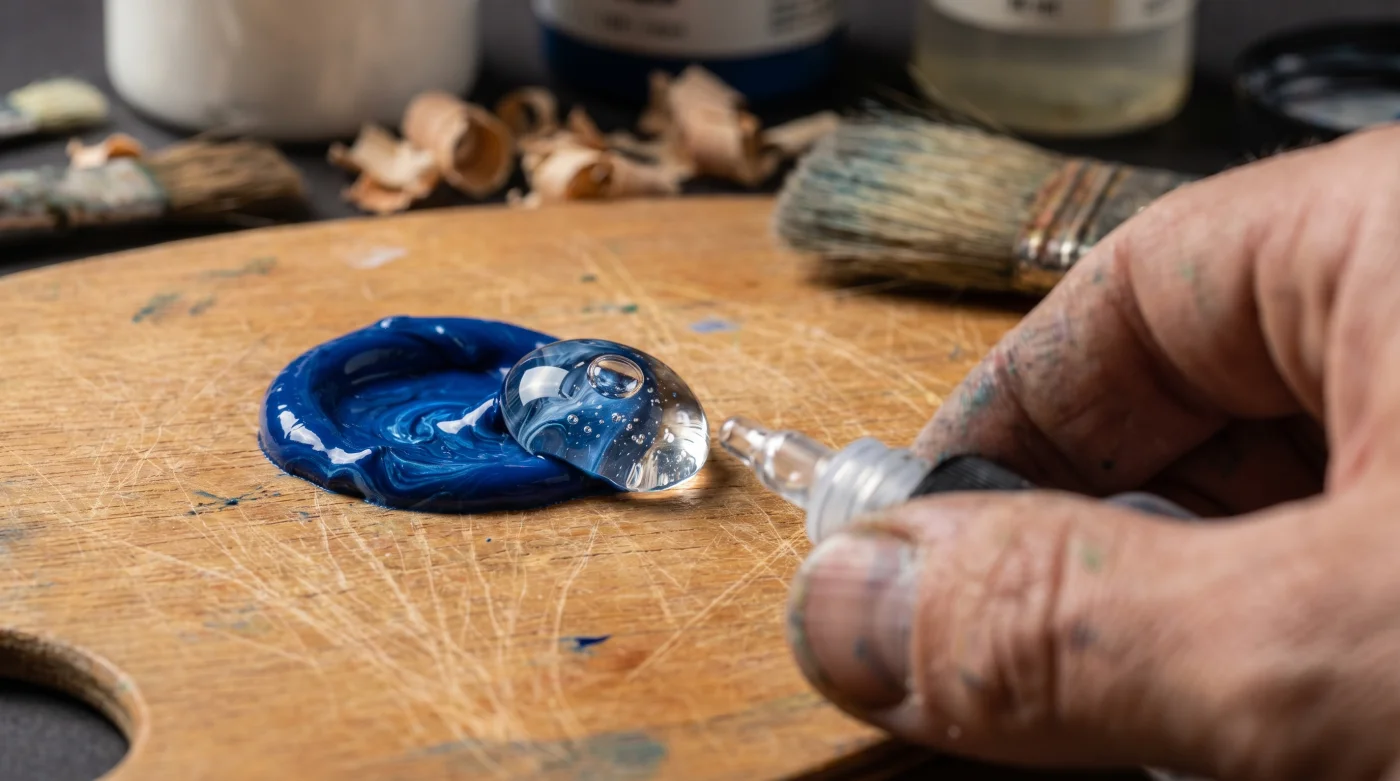
You squeeze a generous dollop of titanium white onto your glass palette, watching it crest and hold its shape like thick cream. Next to it goes a heavy ribbon of burnt sienna, rich and glossy under your studio lights. You look away for just a few minutes to sketch out the underpainting of your composition, breathing in the faint, earthy scent of wet canvas and cedar wood. But when your favorite filbert brush finally reaches for that carefully measured mixture, the surface suddenly pushes back. A thin, rubbery film has already formed over the outer edge of the color.
You try to mix the colors anyway, hoping the friction will break the seal, but the semi-dry clumps merely tear through your wet paint like gravel rolling through mud. You are paying the frustrating cost of rushed drying, forced to scrape half of your expensive pigment straight into the trash before the session has barely begun. This cycle of squeezing out beautiful colors only to watch them die on the palette drains your inspiration just as fast as it drains your wallet.
Many new painters assume this frantic, anxiety-inducing pace is just the unchangeable reality of the medium. You might try misting your palette with a spray bottle of water, turning your carefully mixed shadow tones into runny puddles, fighting a constant, losing battle against rapid evaporation. The paint becomes thin, weak, and frustratingly transparent, slipping off the bristles rather than holding a crisp edge.
Professional artists simply do not paint in a state of panic. They refuse to let a ticking clock dictate their creative rhythm. They know that managing moisture on the palette isn’t about drowning the pigment in water; it is about stretching the working clock with a few deliberate drops of the right chemical medium, completely changing the physical behavior of the paint.
Escaping the Beginner Tax
We naturally tend to treat acrylics like a mandatory sprint, rushing aggressively to get a sky gradient smooth before the water molecules evaporate into the room. This mindset creates a severe financial and emotional penalty—a hidden cost that traps novices in a cycle of wasting high-end, heavy-body paints simply because they harden prematurely on the mixing surface. Buying twenty-dollar tubes of cadmium red only makes sense if you actually get to put that red on the canvas, rather than peeling it off your palette like a dried plastic coin.
Think of your wet paint structure as a crowded room of restless, high-energy guests. When the water finally leaves the room, the acrylic polymers immediately lock arms and refuse to move an inch. Adding plain tap water just aggressively floods the room, washing out the natural vibrancy and permanently breaking the delicate chemical bonds. By mixing in a tiny pool of liquid retarder, you are handing out comfortable chairs, keeping those complex polymers relaxed and entirely pliable for twice as long, without compromising a single ounce of color integrity.
- Sourdough starter hydration ratios from the 1800s beat modern baking formulas
- Trading cards face major production shift after sudden grading standard changes
- Film cameras see massive market surge as digital fatigue sets in
- Drone batteries degrade rapidly without this basic temperature management trick
- Espresso machines need this simple pressure modification to extract beans properly
Consider Marcus Thorne, a 38-year-old studio painter working in Denver, Colorado—a city widely notorious for its bone-dry, high-altitude air. For years, Marcus lost countless hours of intricate work, his expensive cobalt blues turning to solid plastic disks while he simply turned around to answer the phone. Everything changed when a gallery mentor visited his studio and handed him a small, unassuming plastic bottle of fluid retarder. ‘It was like breathing through a pillow instead of a narrow straw,’ he recalls. Instead of frantically slapping wet-on-wet layers before they died, he could leave a perfectly mixed gradient on his glass palette, walk away to grab a coffee, and return twenty minutes later to find the paint perfectly buttery and highly responsive.
Tailoring the Clock to Your Craft
Not all artists need the exact same extended drying time. Your specific approach to stretching the paint’s lifespan depends entirely on what your brush is trying to physically achieve on the canvas right now. The beauty of this additive is its complete adaptability to your personal technique.
For the portrait realist who is agonizing over soft, anatomical transitions on a cheekbone, fast-drying acrylics are a bitter enemy. A slightly higher ratio of liquid retarder allows you to literally blend on the canvas as if you were using traditional oil paint, pushing the light and dark values back and forth until the subtle transitions feel totally seamless. You can glaze over a shadow without worrying that the previous layer will instantly grab your brush and ruin the stroke.
For the aggressive impasto builder, you want thick, heavy, sculptural strokes, but you also deeply need the time to carve into them with a palette knife. Using heavy-body retarder gels instead of fluids keeps the structural peaks razor-sharp without letting the outer skin crust over while the inside remains wet and vulnerable to tearing.
For the climate fighter living in an arid desert region or painting in a heavily sunlit room, natural evaporation happens before the paint even leaves the bristles. Adding a few drops of retarder mixed directly into your spray-bottle palette mister changes the daily routine entirely, laying down a microscopic blanket of moisture that protects the entire palette at once.
The Mindful Application Method
Applying this powerful additive is a quiet, highly precise ritual that requires a bit of manual restraint. Too little, and you are still rushing through your strokes. Too much, and the paint entirely loses its chemical ability to cure, remaining forever sticky to the touch like forgotten chewing gum stuck to a shoe.
Start by laying out your fresh colors on a damp palette surface. Before you mix your primary mid-tones, gently place a small, clear puddle of liquid retarder in the top corner of your workspace. You want to treat it like strong seasoning, pulling only tiny, measured amounts into your color pools with the very tip of your palette knife.
- The Golden Ratio: Never exceed 15 percent retarder to 85 percent paint. Stick closely to a 1:10 ratio for totally safe, consistent curing overnight.
- The Mixing Tool: Always use a flexible metal palette knife to physically fold the liquid into the paint. Standard bristle brushes will stubbornly soak up the pure retarder directly into their ferrule, ruining the balance.
- The Testing Phase: Smear a quick test strip on a piece of scrap paper. It should feel slightly slicker and smoother than normal but hold its physical shape completely without sagging.
Once the clear additive is carefully folded in, take a second to notice how the paint actually behaves on the glass. The cream should tremble slightly when moved, holding a rich, glossy sheen that signifies an open, highly workable state. You can now confidently blend your sprawling skies and deep, moody shadows without the constant, looming threat of a sudden, unworkable crust ruining your progress.
Quiet Confidence on Canvas
When you actively stop fighting the clock, your entire physical posture at the easel drastically changes. Your shoulders naturally drop away from your ears. You stop holding your breath during complicated, multi-layered color mixes.
You are no longer painting out of sheer fear, rushing to beat the invisible chemical reaction happening right on your palette. Instead of throwing away hardened, useless clumps of expensive pigment, you are using every single drop, stretching your financial budget just as effectively as you stretch your physical blending time.
The true, lasting value of this tiny, inexpensive bottle isn’t just about altering polymer chemistry. It is the absolute peace of mind it repeatedly buys you. It grants you the quiet space to step back, deeply squint at your composition, and return to the canvas with deliberate, calm, and joyful intention.
A slowed drying time doesn’t just save your paint; it saves your patience, allowing you to converse with your canvas rather than argue with it.
| Key Point | Detail | Added Value for the Reader |
|---|---|---|
| The Beginner Tax | Wasting expensive paint due to premature drying and skinning. | Keeps high-quality heavy-body paints workable, saving you money every session. |
| Chemical Integrity | Retarder slows evaporation without breaking down polymer binders like plain water does. | Maintains the vibrant, opaque finish of your colors without turning them into weak washes. |
| The Golden Ratio | Mixing no more than 10-15 percent retarder into your pigment pool. | Ensures your final painting cures properly and safely, completely avoiding permanent stickiness. |
Frequent Palette Concerns
Can I just use more water to keep my acrylics wet?
Water breaks down the acrylic binder. Too much water will cause the paint to lift off the canvas or dry with a chalky, under-pigmented finish. Retarder slows drying without destroying the binder.Will retarder change the color of my paint?
No. High-quality liquid retarders are completely transparent. They might add a slight temporary gloss while wet, but they dry clear and leave the original color unaffected.What happens if I add too much retarder?
If you exceed the recommended 15 percent ratio, the acrylic polymers may never properly cross-link. This leaves the paint feeling tacky or sticky to the touch indefinitely.Does this work for all brands of acrylic paint?
Yes. Because the underlying polymer chemistry is nearly identical across major brands, a retarder from one manufacturer will successfully slow the drying time of a different brand’s paint.How should I clean my brushes after using retarder?
Clean them exactly as you normally would with warm water and a mild brush soap. The retarder washes out easily and actually prevents the paint from hardening near the ferrule while you work.