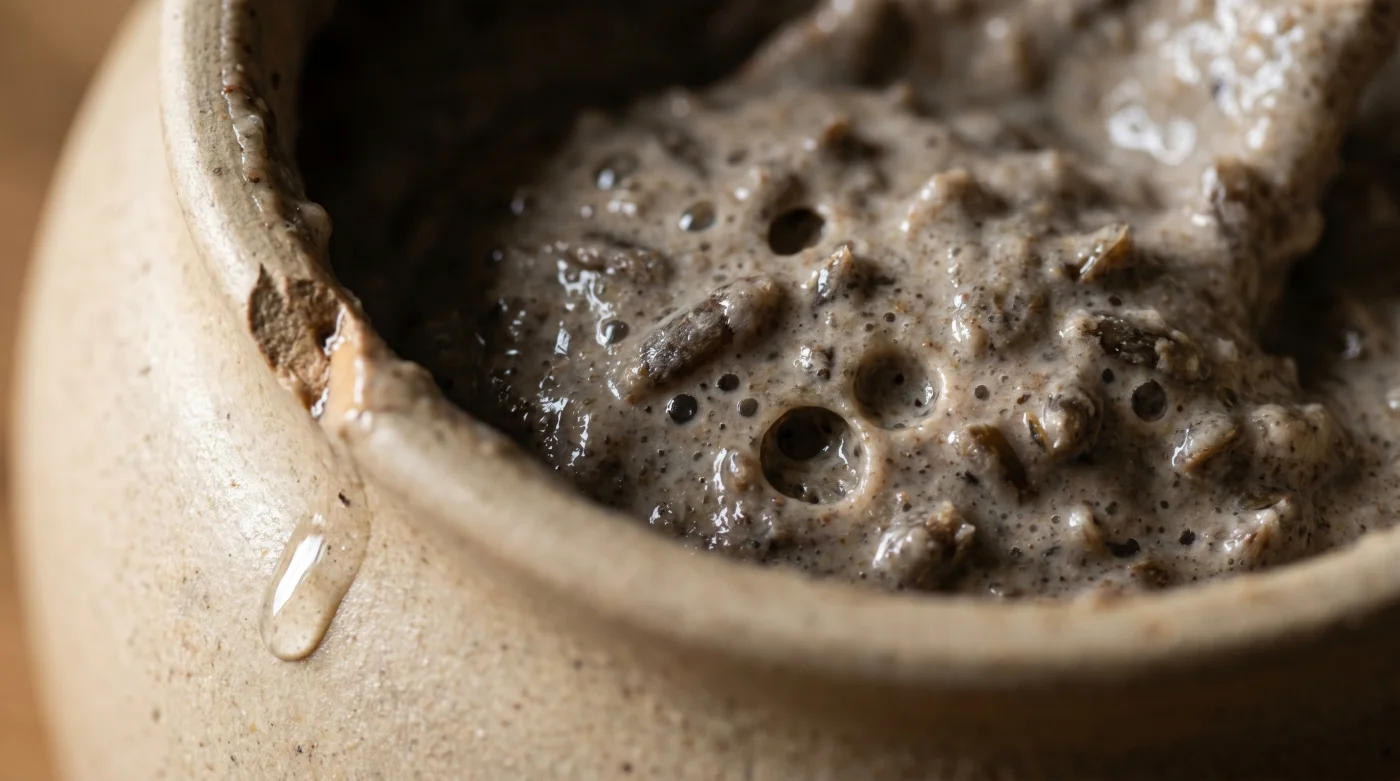
The morning light barely catches the edge of your kitchen counter, and there sits your jar. You pull off the cloth cover, expecting the rounded dome of a healthy culture, but instead, you find a flat, graying liquid smelling sharply of nail polish remover. You did everything the internet told you to do: equal parts unbleached all-purpose flour and water, fed faithfully every twelve hours.
Yet, the dough you mix later will spread into a flat, sticky puddle on your baking stone. You are over-feeding your culture with fuel it was never designed to process. Modern bakers treat their starters like high-performance engines, dumping highly processed white flour into the jar to chase maximum bubbles.
Before commercial yeast homogenized our bread, wild fermentation relied on entirely different mechanics. Back in the 1800s, pioneer bakers and European homesteaders weren’t hovering over digital scales with bags of sifted wheat. They maintained their cultures with coarse, hardy grains, naturally restricting the hydration to create a stiff, almost clay-like paste.
By forcing a modern 100-percent hydration ratio using stripped-down white flour, you are inadvertently breeding an aggressive, highly acidic environment. The acid eventually attacks gluten, breaking down the very structure you need to trap gas. To fix the soupy mess on your counter, we have to look backward.
The Sugar Rush and the Slow Burn
Think of your current feeding routine as giving a marathon runner a fistful of cotton candy. Processed white flour is stripped of its bran and germ, leaving behind easily accessible starches that the yeast and lactic acid bacteria consume in a chaotic frenzy. The population spikes, the jar overflows, and then, hours before you are ready to mix your dough, the food runs out. The bacteria panic, flooding your jar with acetic acid.
The perspective changes when you stop chasing the bubble dome and start managing the microbial diet. In the 1800s, starters were primarily fed whole rye or coarsely ground wheat, mixed with just enough water to form a stiff ball. This low-hydration, high-nutrient environment slows the fermentation rate to a steady, controlled hum.
When you stick to a strict historical rye-to-water ratio, you prevent the acidic breakdown entirely. The complex carbohydrates in rye take longer to digest. The stiff texture physically impedes the rapid spread of acid-producing bacteria, prioritizing yeast development over sourness. You aren’t just changing ingredients; you are redesigning the ecosystem.
Consider Elias Thorne, a 64-year-old heritage grain miller based in rural Vermont. For decades, Elias struggled with starters that turned to soup in the humid summers, until he uncovered a gold-rush era logbook documenting a traveling sour. The pioneers kept their starters buried in flour sacks as dry, crumbly lumps. Elias replicated this, feeding his culture a 2-to-1 ratio of dark rye flour to water. He stopped feeding it twice a day. Instead, his thick, rye-based culture required attention only a few times a week, producing loaves with massive oven spring and a complex, nutty sweetness rather than a harsh, vinegar bite.
Adjusting the Historical Method to Your Kitchen
Not every baker has the exact same rhythm, but this old-world stiff rye approach can be tailored to fit how you naturally operate in the kitchen.
- Trading cards face major production shift after sudden grading standard changes
- Film cameras see massive market surge as digital fatigue sets in
- Drone batteries degrade rapidly without this basic temperature management trick
- Espresso machines need this simple pressure modification to extract beans properly
- Fountain pens under thirty dollars easily outperform luxury gold nib models
For the Weekend Purist
If you only bake on Saturday mornings, keeping a liquid white-flour starter on the counter is a chore. By converting to a stiff 50-percent hydration rye starter, you can feed it once on Wednesday. The stiff dough ferments slowly, holding its peak for nearly two days. You simply pinch off what you need for your weekend levain, leaving the mother culture undisturbed.
For the Sweet Crumb Chaser
Maybe you despise the sharp, tangy flavor of San Francisco-style sourdough and just want the keeping qualities of natural leavening. Lactic acid thrives in wet environments, while acetic acid spikes when a wet starter starves. A stiff rye starter dramatically reduces acid production, resulting in a mild, milky flavor profile that lets the actual grain shine through.
For the Rescue Operator
If your current jar smells like harsh acetone and behaves like pancake batter, you don’t need to throw it away. You just need to change its diet. Take a spoonful of sludge and knead it into a heavy mound of rye flour. The turnaround will happen within forty-eight hours.
The Stiff Rye Protocol
Transitioning your culture requires a few deliberate, mindful steps. You will abandon the liquid pour and embrace the tactile sensation of kneading a tiny ball of dough. It should feel like modeling clay, firm and slightly tacky.
Here is your Tactical Toolkit to achieve the 1800s stabilization method:
- The Ratio: 1 part existing starter, 2 parts water, 4 parts whole dark rye flour.
- The Temperature: Keep the ambient resting environment around 68 to 72 Fahrenheit.
- The Vessel: A wide-mouth glass jar or a small ceramic crock. No airtight lids.
Start by dissolving your current starter into the water. Use your fingers to mix, feeling for any hardened clumps. Once the liquid is milky, add the rye flour.
Stir with a sturdy spoon until shaggy, then turn it out onto your counter. Knead the small mass for roughly thirty seconds until no dry spots remain.
Place the dense ball back into your jar and gently press it down so it makes contact with the bottom. Score an ‘X’ into the top of the dough with a sharp knife; this helps you track the physical expansion.
Leave it in a quiet, temperate corner of your kitchen. You will know it is ready to use when the ‘X’ has splayed completely open and the dough feels hollow when gently squeezed.
The Quiet Confidence of a Stable Culture
When you stop trying to force an old-world mechanism to run on highly processed modern fuel, a sudden sense of calm takes over your baking routine. You no longer have to time your dough mixing to a fleeting thirty-minute window of peak starter activity.
A stiff rye culture is forgiving. It waits for your schedule, holding its strength long after a liquid white starter would have collapsed into an acidic puddle. You are no longer managing a fragile, demanding pet on your kitchen counter.
Instead, you are maintaining a resilient piece of history. By respecting the physical limits of wild yeast and providing the complex nutrition it evolved to consume, you gain total control over your bread. The panic of the deflated dough disappears, replaced by the quiet assurance that your foundation is solid.
Baking is not about imposing your will on the ingredients; it is about creating an environment where the culture can thrive at its own natural pace.
| Key Point | Detail | Added Value for the Reader |
|---|---|---|
| Flour Type | Whole dark rye vs. processed white flour. | Provides sustained, slow-release nutrition, preventing the harsh acid spikes that destroy gluten. |
| Hydration Level | Stiff 50% hydration vs. liquid 100% hydration. | Creates a physical barrier that slows bacterial acid production, allowing you to bake on your own schedule. |
| Feeding Frequency | 1-2 times a week vs. twice daily. | Eliminates the stressful, high-maintenance chore of constant feeding and massive flour waste. |
Frequently Asked Questions
Will a rye starter make my white bread taste like rye?
No. You only use a tiny portion of the starter to build your levain. The small amount of rye acts as a nutritional booster without altering the final flavor of a white loaf.
How long does it take to convert my current liquid starter?
You will see a change in texture and smell within 24 hours. After two or three feedings at the new stiff ratio, it will be fully adapted to the 1800s method.
Do I need to keep this stiff starter in the refrigerator?
You can, but its slow fermentation rate means it can happily survive on the counter for days between feedings without breaking down into a soupy mess.
Why is my stiff starter growing mold on top?
Because it ferments slower, the top can dry out if exposed to too much air. Keep a loose-fitting lid or a heavy cloth over the jar to maintain humidity without sealing it completely.
Can I use whole wheat instead of rye?
Yes, coarse whole wheat works well as a substitute. However, rye possesses specific enzymes that attract wild yeast more effectively, making it the most robust option for a stable culture.