You know the sound before it happens. The crisp, crinkling snap of foil yielding to your thumb. The distinct scent of gloss and fresh paperboard hits the air, smelling faintly like a high-end printing press. You slide the newest addition from the pack, holding it by the edges, waiting for the light to catch the holographic foil. For decades, the thrill lived entirely in the image staring back at you.
But the room has changed. Today, the modern collector barely registers the artwork. Instead, your eyes dart to the margins. You are looking for a ghost—a fractional variance in the cardboard framing that separates a retirement fund from loose change. The reality of modern collecting is no longer just about the character or the athlete; it is about the geometry of the paper.
Right now, the largest grading institutions in the country are silently rewriting the rules of perfection. They are penalizing off-center prints at historic, ruthless rates. What used to pass as a pristine, mint-condition specimen is now being heavily downgraded, leaving collectors staring at their plastic slabs in disbelief.
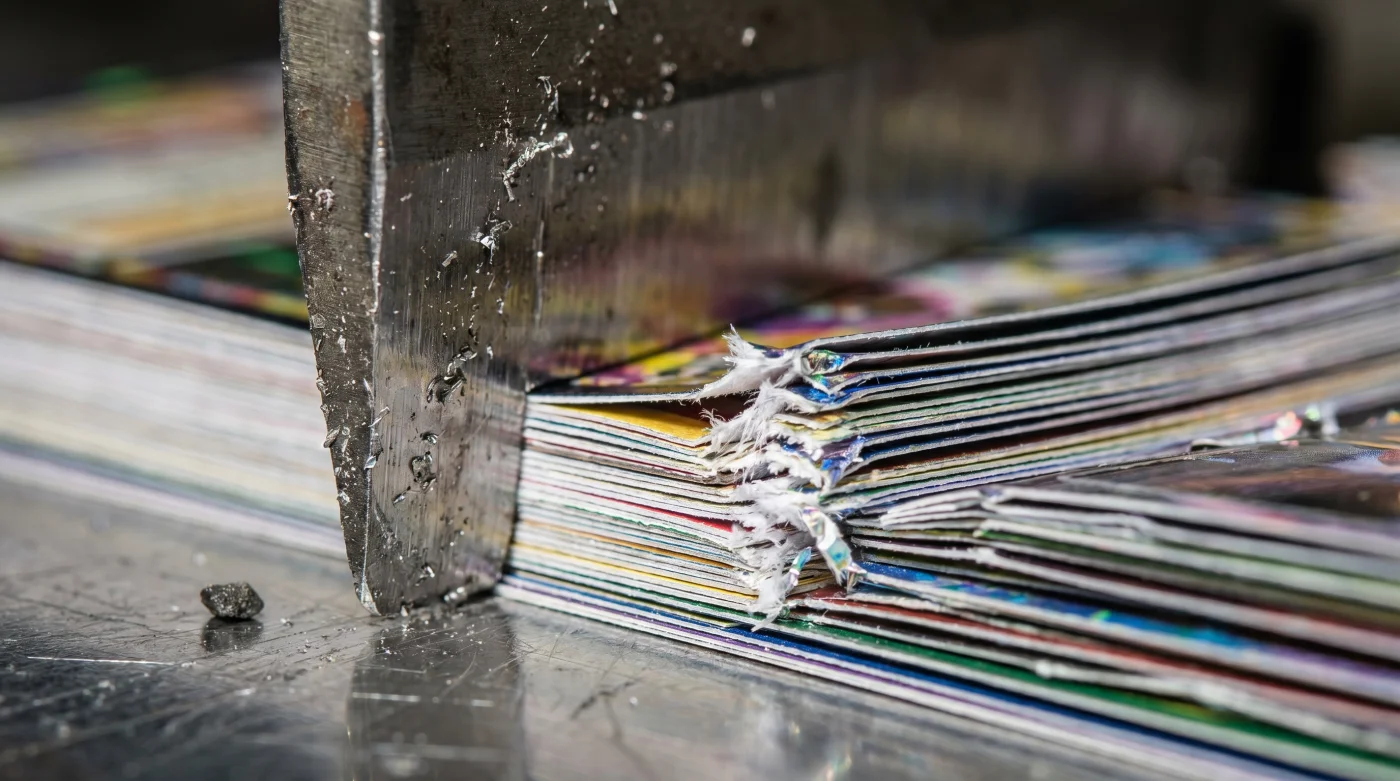
Manufacturers are overhauling production drastically to retain your trust. The sudden shift in grading standards has forced the people making the cards to rethink how a steel blade drops onto a sheet of paper.
The Anatomy of a Perfect Cut
There is a strange mythology in the hobby that printing companies are infallible machines, churning out exact replicas by the millions. Think of the printing process less like a digital download and more like baking a thousand loaves of bread in an industrial oven. Heat, humidity, and the microscopic dulling of steel blades all change the final product.
Borders dictate the telltale pulse of the factory floor. When grading companies suddenly tightened their tolerances for centering—demanding a near-microscopic symmetrical split on the front—they turned a mundane detail into the hobby’s biggest battleground. A left border that is two millimeters thicker than the right is no longer just a printing quirk. It is a financial penalty.
Consider the life of Julian Vargas, a 46-year-old former print technician who now works as an independent authentication consultant in Dallas. Julian spent a decade calibrating the hydraulic die-cutters that punch out these very sheets. ‘People think the cards are cut by lasers,’ he notes over a coffee, sketching a grid on a napkin. ‘They are punched by massive steel cookie cutters. After fifty thousand sheets, the blade blunts by a fraction of a hair. The paper shifts. The grade drops.’ Julian points out that the recent grading crackdown has forced manufacturers to retire their cutting dies at a fraction of their usual lifespan, sacrificing millions in overhead to ensure those borders stay dead-center.
- Film cameras see massive market surge as digital fatigue sets in
- Drone batteries degrade rapidly without this basic temperature management trick
- Espresso machines need this simple pressure modification to extract beans properly
- Fountain pens under thirty dollars easily outperform luxury gold nib models
- 3D printer bed adhesion fails without this basic hardware store item
This industrial pivot leaves you standing in the middle of a massive transitional era. The way you evaluate a card depends entirely on when it rolled off the press.
Mapping the Adjustment Layers
If you are buying ungraded cards fresh from the pack today, you are interacting with the new die-cut reality. Manufacturers have slowed down their automated cutting lines. For you, this means modern sets will feel physically different. The edges will feel sharper, almost capable of drawing blood.
Verify the exact margin alignment before shipping anything off for a slab. Trust the new factory tolerances, but maintain your skepticism.
If your collection is rooted in releases from three to five years ago—right before the grading standards shifted—you hold a volatile asset. The cards printed during the peak of the recent boom were subjected to exhausted cutting dies. Finding a perfectly centered specimen from this window is suddenly much harder than anyone realized.
Finding symmetry in mass production is your major advantage. What was once considered a common flaw is now the primary filter for rarity.
Assessing the Die-Cut Reality
Bringing this knowledge into your physical space requires a minimalist approach. You do not need a laboratory, just a quiet desk, a good light source, and an understanding of the mechanics.
Train your eyes to scan the cardboard systematically. Stop looking at the subject of the card and start reading the frame.
Here is your tactical toolkit for the modern grading landscape. First, use a simple, clear acrylic centering overlay to calculate the exact percentage of the margins. Second, hold the card under a bright halogen bulb; a clean edge means a fresh die, while a fuzzy edge indicates a worn blade. Finally, gently bow your penny sleeves open before use to protect those newly sharp factory corners.
Never evaluate in a vacuum. Always compare three or four cards from the same print run to spot systemic sheet misalignments rather than isolated errors.
Trusting the Cardboard Again
When an entire industry shifts its manufacturing process just to meet the demands of a plastic slab, it changes the way you interact with your collection. It is easy to feel frustrated by the moving goalposts of grading standards.
But this friction breeds longevity. Manufacturers are being forced to care about the physical integrity of the cardboard as much as you do. When the cutting dies are sharp and the borders are true, the hobby strips away the noise of factory errors.
You are left with a cleaner, more reliable pursuit. You no longer have to guess if the card in your hand was ruined before it even hit the foil wrapper.
Understanding the mechanical reality today lets you look at a stack of cards and see the exact moment the industry decided to hold itself to a higher standard.
The hobby does not live in the foil; it breathes in the microscopic margins where the steel meets the paperboard.
| Key Point | Detail | Added Value for the Reader |
|---|---|---|
| Die-Cut Lifespan | Manufacturers now replace cutting blades forty percent faster. | Guarantees sharper corners and symmetrical borders on new packs. |
| Centering Tolerances | Grading institutions strictly enforce a perfect margin split. | Protects your investment by standardizing true mint condition. |
| Era Volatility | Print runs from three years ago suffer from dull-blade misalignment. | Creates a hidden rarity market for perfectly centered older cards. |
Frequently Asked Questions
Why are older mint cards getting lower grades? Grading institutions recently updated their manual tolerances, penalizing microscopic off-center borders that previously passed inspection.
How do I check centering at home? Use a clear acrylic centering overlay tool to measure the exact percentage split between the left and right margins before grading.
Are manufacturers actually changing how they print? Yes. To combat harsh grading penalties, major factories are replacing their steel cutting dies earlier to prevent paper shifting.
Does this make older off-center cards worthless? Not worthless, but their ceiling is capped. However, perfectly centered cards from that same older era are now drastically more valuable.
Should I grade fresh pulls immediately? Always audit them yourself first. While new cutting dies produce better margins, micro-chipping on the sharper edges can still occur.