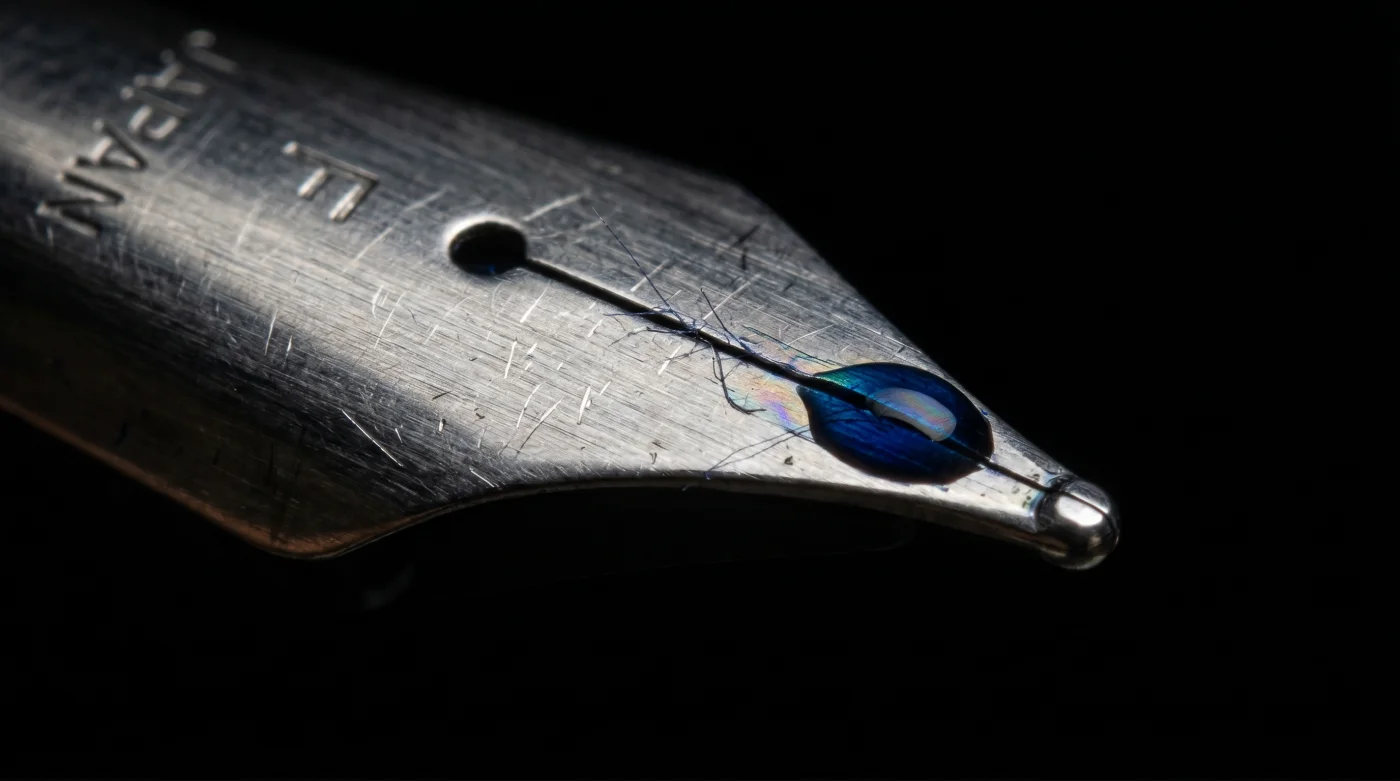
You sit down at your desk, the morning light catching the polished resin and cold gold trim of a freshly unboxed luxury fountain pen. It feels substantial in your fingers. The heavy brass core inside the barrel gives it a gravity that whispers of old money, slow deliberate letters, and a romanticized vision of authorship. You uncap it, expecting the ink to hit the paper like a quiet revelation.
Then you make the first stroke. The nib catches on the page, the ink skips, and a thin, scratching sound interrupts the silence of the room. You press a little harder, trying to force the liquid out, only to realize your three-hundred-dollar investment writes with less grace and reliability than a disposable rollerball you left in your glovebox.
You reach into your bag and pull out a cheap, plastic-bodied pen you grabbed from a blister pack at the stationery store. You touch the steel tip to the paper. The ink flows instantly, gliding like water over glass, leaving a crisp, flawless line that dries perfectly. The contrast is entirely baffling.
For decades, we have been sold a specific mythology about weight and precious metals. We are taught that a heavy brass pen is a reliable pen, and that a gold nib is the absolute ceiling of the writing experience. But the reality resting in your hand tells a different story entirely: the true joy of writing lives in the strict engineering tolerances of affordable steel.
The Illusion of Weight and Wealth
Think of a fountain pen like a finely tuned acoustic instrument. Wrapping a guitar in thick brass and gold plating might make it look impressive hanging on a studio wall, but it does absolutely nothing to improve the resonance of the strings. In the world of fountain pens, the nib is the vibrating string, and the plastic feed tucked underneath it is the soundboard. When you pay a premium for a luxury model, you are often paying for the intricate swirling acrylics, the brand’s century-old heritage, and the heavy piston mechanisms. You are simply buying jewelry that happens to hold ink.
Entry-level Japanese steel nibs operate on an entirely different philosophy. Brands like Pilot, Platinum, and Sailor dedicate their manufacturing budgets to precision over aesthetic luxury. Their basic steel nibs are stamped and folded by machines calibrated to microscopic tolerances. Unlike hand-ground gold nibs, which can easily suffer from human error and arrive with misaligned tines, these affordable steel tips are perfectly uniform. Gold is a naturally soft metal; it bends and deforms if you press too hard. Steel is incredibly resilient. It snaps back immediately, ensuring the capillary action—the physical physics that pulls ink from the reservoir to the paper—remains unbroken.
There is a quiet dignity in stripping away the excess weight. When you stop chasing the heaviest brass barrel in the display case, you realize that a lighter, perfectly balanced body allows your hand to move across the page without fatigue. You stop gripping the section so tightly. You stop trying to control the tool and start letting it do the heavy lifting.
The Nibmeister’s Secret
Arthur Vance, a 58-year-old nib mechanic working out of a dusty, ink-stained studio in Portland, knows this reality better than anyone. He spends his afternoons hunched over a magnifying loupe, grinding and realigning the delicate gold nibs of thousand-dollar Italian masterpieces that refuse to write straight out of the box. Yet, if you look in the chest pocket of his denim apron, you will always find a fifteen-dollar Pilot Metropolitan. He affectionately calls it his ‘reality check.’ Arthur frequently hands it to clients who complain about their luxury pens, watching their faces drop as they experience the flawless, factory-machined perfection of a cheap Japanese steel nib that dramatically outperforms their heirloom pieces every single time.
Finding Your Ideal Steel Companion
Not all budget pens are created equal. The trick is knowing which specific engineering profile matches your daily routine and writing style. By categorizing these everyday tools, you can find the one that feels less like a purchase and more like an extension of your own hand.
For the Heavy-Handed Writer
If you have spent your life pressing hard into ballpoints to force the thick paste ink out, switching to a fountain pen can feel like writing on ice. The Platinum Preppy is your ideal bridge into this world. Costing less than a cup of artisanal coffee, its steel nib is robust enough to survive a heavy grip without springing the tines. It also features a patented slip-and-seal cap, meaning you can throw it in a desk drawer for six months and the ink will never dry out.
For the Professional Minimalist
You want a pen that looks respectable in a boardroom but costs less than a decent lunch. The Pilot Metropolitan is the gold standard here. It features a brass body—giving you that tactile weight you might still crave—but its heart is a strictly calibrated Japanese steel nib. It delivers a line so consistently clean that it makes your quick meeting notes look immediately more deliberate and thoughtful.
For the Visual Thinker
If you sketch, diagram, or write tiny marginalia in dense textbooks, you need microscopic precision. The Pilot Kakuno, outfitted with an Extra-Fine steel nib, produces lines thinner than a human hair. Because Japanese nibs are historically much finer than their European counterparts, this affordable steel tool offers exactness that broad, wet, and incredibly expensive gold nibs simply cannot physically match.
Mindful Application: Tuning Your Habit
Owning a highly reliable tool is only half the equation; the other half is integrating it into your day without overcomplicating the entire process. You do not need expensive leather cases, imported blotting paper, or a library of specialized inks to enjoy a perfectly functioning steel nib.
Start by letting gravity do the heavy lifting. A well-engineered steel feed requires zero downward pressure to function. If you find your hand cramping after a paragraph, you are squeezing the barrel too hard. Imagine holding a small, fragile bird—firm enough that it does not escape, but gentle enough that it can breathe easily.
To keep your everyday carry performing perfectly, rely on a simple, minimalist tactical routine:
- Flush with cool water: Every time you change ink colors, draw room-temperature tap water through the nib and feed until it runs perfectly clear. Never use hot water or alcohol, which warp the plastic.
- Pair with coated paper: Invest in notebooks made in Vietnam or Japan. The specific sizing on the paper prevents the water-based ink from feathering, allowing the steel nib to glide effortlessly.
- Store horizontally: When resting the pen on your desk overnight, lay it flat. This keeps the feed properly saturated without pooling excess ink into the cap.
- Embrace the cartridge: While filling from a glass bottle of ink feels romantic, proprietary plastic cartridges offer the most reliable, chemically balanced ink flow for daily office use.
The Quiet Confidence of a Working Tool
There is a profound peace of mind that comes from carrying a tool that just works without asking for special treatment. When you spend hundreds of dollars on a luxury pen, you subconsciously become a custodian of a fragile object. You worry constantly about scratching the polished resin, dropping the soft gold nib, or leaving it behind at a coffee shop table. That low-level anxiety inevitably leaks into your writing process. You hesitate before you put pen to paper.
A thirty-dollar Japanese steel pen frees you entirely from that burden. It is a brilliant workhorse, perfectly designed to be tossed into briefcases, lent to curious friends, and used aggressively to capture fleeting thoughts before they vanish into the noise of the day. It reminds us daily that the value of writing is never found in the expensive materials of the barrel, but in the clarity of the words left behind on the page.
A pen is simply a conduit for thought; if you notice the pen while you are writing, the tool has fundamentally failed you.
| Key Point | Detail | Added Value for the Reader |
|---|---|---|
| Precision Over Prestige | Machine-stamped Japanese steel nibs offer tighter, more uniform tolerances than hand-ground gold. | Eliminates skipping and scratchiness straight out of the blister pack. |
| Structural Resilience | Steel snaps back into shape immediately; gold is soft and easily sprung by heavy pressure. | Provides a highly durable writing experience for those transitioning from ballpoints. |
| Anxiety-Free Utility | Costs well under thirty dollars to replace if lost, stolen, or accidentally damaged. | Allows you to carry and use the pen aggressively anywhere without fear of financial loss. |
Frequent Curiosities
Does a steel nib scratch the paper more than gold?
Not if it is tuned correctly at the factory. Scratchiness usually comes from misaligned tines catching the paper fibers, not the metal material itself. Factory-machined Japanese steel is often noticeably smoother than poorly adjusted luxury gold.Can I use any ink in these budget fountain pens?
Stick strictly to fountain pen-specific inks. Calligraphy or India inks contain shellac and binders, which will permanently clog the delicate plastic capillary feeds of these pens.Why do Japanese pens write so much finer than others?
The Japanese language requires complex kanji characters written cleanly in very small spaces. Therefore, a Japanese ‘Medium’ nib is generally equivalent to a European ‘Fine’ nib.Do I need to break in a steel nib over time?
No. High-quality steel does not conform to your writing angle over time like some vintage materials might. It should write perfectly the moment ink hits the feed.How long will a thirty-dollar pen actually last me?
With basic rinsing every few months and keeping the cap securely sealed when not in active use, a quality plastic and steel pen will easily outlast your lifetime.